Munich’s center is a story you can walk through. This essential walking tour threads you through the big squares and churches with a local guide, then slows down just enough to make the details stick. I like how the meeting is simple at Karlsplatz, and I also like the way the route feels personal even though you’re ticking off classic highlights.
The best part for me is the pacing. Stops are grouped tightly, so you’re not doing constant long-haul walking, and your guide keeps the conversation flowing with context (and, in more than one case, printed pages and historical pictures). If you’re the type who likes to ask questions and grab a few photos without feeling rushed, this setup fits.
One possible drawback: it’s a weather-dependent outdoor walk, and the tour is listed for moderate physical fitness. Also, with a 12:00 pm start, it’s best for travelers who like a mid-day plan rather than an early morning sprint.
In This Review
- Key points you’ll care about
- What makes this Munich walk feel different than a checklist
- Price and value: what $360.42 means in real life
- Your start at Marienplatz/Karlsplatz and why the timing matters
- Stop 1: Frauenkirche and the brick-cathedral legend
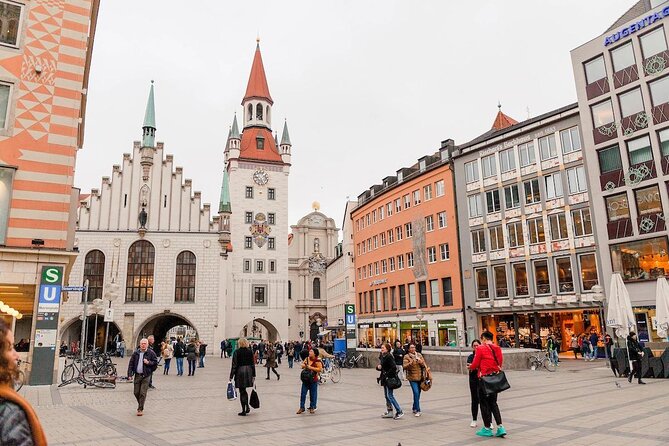
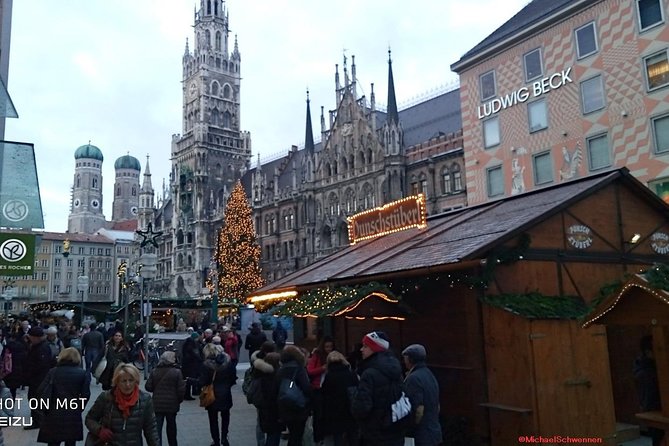
- Stops 2 and 3: New Town Hall Glockenspiel plus Old Town Hall traditions
- New Town Hall (Neues Rathaus) and the Glockenspiel
- Old Town Hall and the city’s darker quirks
- Stop 4: Viktualienmarkt tasting—food, not just photos
- Stop 5: St. Peter’s Church—tower views and the style timeline
- Stop 6: Ohel Jakob Synagogue and the Jerusalem reference
- The guide factor: Michael’s style and why it shows up in the route
- How the route feels on your feet: tight stops, less strain
- What you’ll do after the tour
- Should you book this Munich essential walking tour?
- FAQ
- FAQ
- How long is the Munich essential walking tour?
- What is the meeting point and start time?
- Is this tour private?
- What language is the tour in?
- What’s included during the Viktualienmarkt stop?
- Is admission included for St. Peter’s Church?
- Do I need to buy tickets for other stops?
- Do they use a mobile ticket?
- Are service animals allowed?
- What happens if the weather is bad?
Key points you’ll care about
- Easy start near Marienplatz and Karlsplatz so you can settle in quickly
- Private group up to 10 with more time for questions and photos
- Glockenspiel and old-town legends explained in plain language
- Viktualienmarkt tasting time for soup, bread, coffee, beer, and local specialties
- St. Peter’s Church tower views plus the mix of styles from Romanesque to Gothic to Baroque
- Ohel Jakob Synagogue stop that connects Munich to Jerusalem-style design
What makes this Munich walk feel different than a checklist
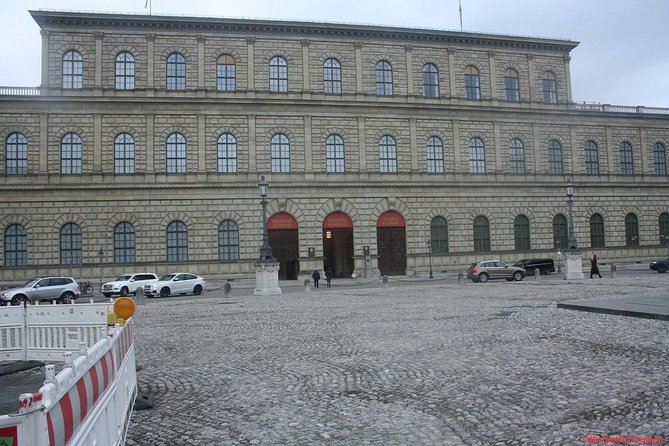
Munich is full of impressive buildings, but the difference between seeing and understanding is your guide. Here, the tour is built around a compact core of sights, so you get context while your legs are still fresh. It also stays limited to just your group, which changes the whole feel: you can actually talk, ask follow-ups, and not wait for a big crowd to catch up.
A big win is that the route concentrates on the places that “explain” the city—Marienplatz area landmarks, the civic buildings around it, a food-market stop, then back to the church-and-square vibe. Your guide isn’t just pointing and moving; they’re connecting the dots between architecture, local traditions, and how Munich grew into what you see today.
I also appreciate the structure: the tour is short enough to keep your energy, but long enough to cover more than just the postcard stops. Expect about 2 to 3 hours, and a schedule that includes dedicated time at each major location rather than a quick stop-and-go.
You can also read our reviews of more walking tours in Munich
Price and value: what $360.42 means in real life
The price is $360.42 per group (up to 10 people). That means your per-person cost depends entirely on how many you bring.
- If you roll in as a group of 6, you’re looking at roughly $60 each.
- As a group of 2, it’s closer to $180 per person.
- With a full group near 10, it’s about $36 per person.
Is it “worth it”? For me, the value comes from the private format and the time your guide can spend with your questions. You’re not competing with other groups for attention, and the pacing is built so the story lands. If you’re traveling as a couple or small family, it’s a splurge—but it’s a splurge that buys you a calmer, more personal experience.
Your start at Marienplatz/Karlsplatz and why the timing matters
The tour meets in central Munich, with an easy meetup at Karlsplatz and the activity start listed at Marienplatz (80331 München). The start time is 12:00 pm, and it ends back near the meeting point.
That midday timing can be great. It works well if you want a “core Munich” walk after a late morning or a relaxed breakfast. It also pairs nicely with an afternoon plan, since you’ll finish with your bearings and a better sense of where things are.
Tip: wear shoes that are comfortable for steady walking on uneven old-town surfaces. The tour is rated for moderate physical fitness, and you’ll be on your feet through multiple stops.
Stop 1: Frauenkirche and the brick-cathedral legend
Your first major landmark is Frauenkirche. This is one of those buildings where the details matter. It’s described as a major brick cathedral, and your guide shares a colorful story about the devil being astonished—local folklore like that is one of the reasons these tours feel alive instead of sterile.
What you’ll get here:
- A first look at a defining Munich icon
- Orientation for the rest of the walk
- An explanation that frames why this church became so important in the city’s identity
The stop is allotted about 45 minutes, and entry is listed as free. In practice, that time is useful: you’re not just standing for a quick snapshot. You can take in the exterior, get context, and understand what you’re looking at before moving on.
Possible drawback: because it’s a headline sight, it can also be busy at midday. Your guide’s pacing helps, but if you’re very photo-focused, be ready to work around foot traffic.
Stops 2 and 3: New Town Hall Glockenspiel plus Old Town Hall traditions
From Frauenkirche, you head to the civic heart—this is where Munich’s public life shows up in stone.


New Town Hall (Neues Rathaus) and the Glockenspiel
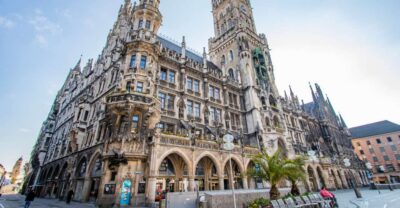
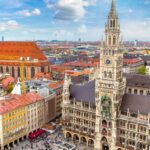
At the New Town Hall, you’ll spend about 30 minutes. The big moment here is the Glockenspiel, and the story you’ll hear includes a marriage theme plus the legendary Scheffler dance. Even if you’ve seen images before, this kind of guided explanation helps you connect what you’re hearing/seeing with the local tradition behind it.
You’ll likely appreciate this stop most if you like cultural details. It turns a “pretty moving clock” into something tied to Munich’s identity.
Entry here is listed as free.
Old Town Hall and the city’s darker quirks
Next is the Old Town Hall for about 20 minutes, with local stories that go beyond the polite version of civic history. You’ll hear about the lottery being conducted in earlier times, a tradition connected to the Night of the broken glass, and the Moriekendancer tradition continuing since the late Middle Ages.
Here’s why this stop works: it adds contrast. The New Town Hall side feels ceremonial and polished; the Old Town Hall side feels messier and more human. Your guide’s job is to make those differences make sense.
Entry is listed as free, and since these civic sites are close, you won’t burn energy between them.
Stop 4: Viktualienmarkt tasting—food, not just photos
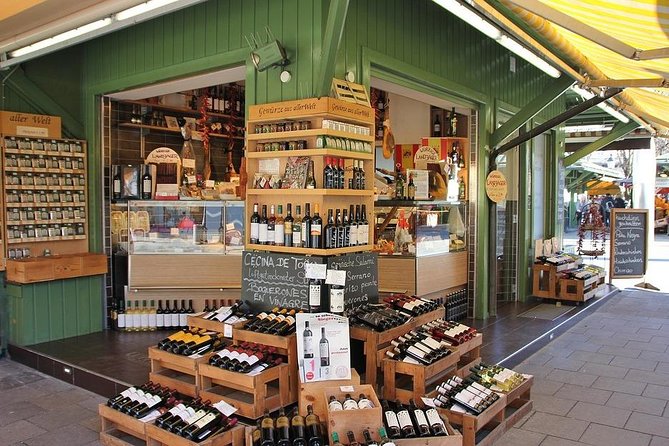
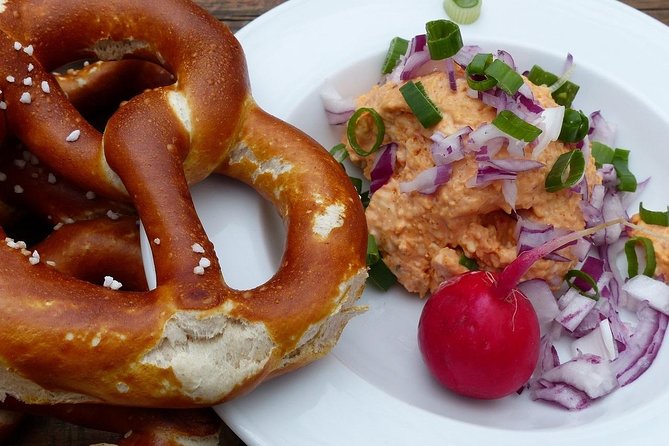
Then you shift gears to Viktualienmarkt, with about 1 hour for tasting and sampling. This is a big reason to book the tour, because it’s the one stop where you get something practical right away: you can taste and compare local specialties without building a full food itinerary of your own.
What’s included as part of this stop is described as:
- tasting and smelling local products
- local specialties
- soup, bread, coffee, and beer
The exact variety isn’t specified, but the concept is clear: your guide helps you approach the market like a local shopper, not a tourist scanning a long menu.
Why this matters: market time makes the tour feel earned. After the churches and town halls, you get a reset for your senses and your feet. It also gives you ideas for what to eat later on your own, because you’ll leave with a clearer sense of Munich flavors.
Possible consideration: markets can be lively, especially in good weather. The tour’s pacing usually protects you from long waits, but it’s smart to expect some normal crowd energy.
Stop 5: St. Peter’s Church—tower views and the style timeline
St. Peter’s Church is the standout “inside-and-out” stop. You spend about 45 minutes, and admission is listed as included.
This church is described as the first church built in Munich, and your guide walks you through a style timeline:
- Romanesque roots (described as Romanian style in the tour notes)
- later Gothic changes
- then Baroque updates, including ceiling paintings and a high altar
And yes, there’s a payoff: from the tower, you get a great view over the old city of Munich. That tower moment is the kind of perspective that makes the earlier stops feel connected. You can look back at what you just walked around.
What I like about this stop is the way the architecture becomes a story you can follow. Instead of treating the church as a single static monument, you learn it as something that evolved—like Munich itself.
Possible drawback: if you don’t enjoy heights or you’re sensitive to crowds during peak entry times, plan to go slowly and take your time with the guide’s suggested rhythm.
Stop 6: Ohel Jakob Synagogue and the Jerusalem reference
The final main stop is Ohel Jakob Synagogue on Saint Jakobs Square. It’s a shorter visit—about 15 minutes—and entry is listed as free.
The key detail here is design: the synagogue is described as resembling the Temple in Jerusalem. Even with a brief stop, this is meaningful because it expands the tour beyond the most obvious “only-in-Munich” sights. It adds another layer to the city’s identity, and it gives you a chance to notice how Munich’s religious and architectural storytelling reaches beyond its walls.
If you’re into cultural variety, this quick stop punches above its weight.
The guide factor: Michael’s style and why it shows up in the route
In multiple experiences, the guide named Michael (and in one case referenced as Mr Schwennen) is praised for being engaging, friendly, and good with pacing. A recurring theme: the tour gives time to ask questions, stop for photos, and not feel like you’re being rushed from one corner to the next.
One specific thing I’d watch for in a tour like this is whether it’s too “lecture-y.” Here, the tone sounds conversational—especially at the civic stops where stories can easily turn into a dump of dates. You’ll also see evidence of support materials like printed pages and historical pictures, which helps you remember what you just heard.
There’s also a practical side mentioned in reviews: on at least one occasion (New Year’s Day), Michael offered breakfast direction because shops were closed. That’s a reminder that a good local guide isn’t just selling facts—they’re helping you travel smarter in the moment.
How the route feels on your feet: tight stops, less strain
The stops are close enough that the walk feels manageable. You’ll go from major squares to churches to the market without long dead stretches. That’s a big deal for a 2–3 hour tour: it means you spend time watching and learning instead of just moving.
Still, it’s not a sit-down experience. You should expect steady walking and standing at viewpoints (especially around churches). If you’re traveling with a stroller or you have mobility limits, it’s worth thinking carefully about the moderate fitness requirement before booking.
What you’ll do after the tour
One underrated benefit of a compact “essential” tour is that it makes the rest of your day easier. After the route:
- you know where Marienplatz sits in relation to major churches and civic landmarks
- you’ve tasted local market items, so you know what to look for later
- you understand the city’s visual landmarks well enough to explore on your own
So even if you don’t continue the itinerary, you’ll still get value from the mental map.
Should you book this Munich essential walking tour?
Book it if you want:
- a private Munich introduction for a small group up to 10
- an English-friendly guide who explains what you’re looking at
- a mix of architecture, civic traditions, and one real food stop at Viktualienmarkt
- tower views from St. Peter’s Church that help you orient the city fast
Skip it or rethink it if:
- weather is a big unknown for your dates (this tour requires good weather)
- you need a very short walk with minimal standing
- you’re only interested in one or two landmarks and don’t care about traditions and market culture
If you’re planning your first day or first afternoon in Munich, this is a strong way to get oriented and leave with stories you’ll actually remember.
FAQ
FAQ
How long is the Munich essential walking tour?
It runs about 2 to 3 hours.
What is the meeting point and start time?
The tour starts at Marienplatz, 80331 München, Germany with an easy meetup with your guide at Karlsplatz. The start time listed is 12:00 pm.
Is this tour private?
Yes. It’s a private experience, limited to just your group (up to 10 people).
What language is the tour in?
The tour is offered in English.
What’s included during the Viktualienmarkt stop?
You’ll have time for tastings and food from the market, including items described as soup, bread, coffee, and beer, along with local specialties.
Is admission included for St. Peter’s Church?
Yes. St. Peter’s Church includes admission.
Do I need to buy tickets for other stops?
For several stops, admission is listed as free, including Frauenkirche, New Town Hall (Neues Rathaus), Old Town Hall, and Ohel Jakob Synagogue.
Do they use a mobile ticket?
Yes, the tour includes a mobile ticket.
Are service animals allowed?
Yes, service animals are allowed.
What happens if the weather is bad?
The tour requires good weather. If it’s canceled due to poor weather, you’ll be offered a different date or a full refund. You can also cancel for free up to 24 hours in advance for a full refund.