REVIEW · MUNICH
Best of Munich Electric Bike Tour
Book on GetYourGuide →Operated by Fat Tire Tours - Munich · Bookable on GetYourGuide
Munich on an e-bike feels built for day one. You’ll glide through royal squares and the darker Nazi-era story with easy e-bike pacing and clear explanations, not just a bunch of quick photo stops.
The big win is the guide—Rob G in particular—making places like Königsplatz and Führerbau feel understandable and memorable, with safety-first riding and helpful photo moments.
One consideration: the route can include busier streets, so you’ll want to stay alert; and while helmets are part of the tour, one rider flagged a helmet snag, so check right at the start before you roll.
In This Review
- Key highlights worth planning around
- Why this Munich e-bike route works in just 4 hours
- Starting at Karlspl. 4: easy logistics, lots of stops
- Königsplatz and the Bavarian royal story you can actually see
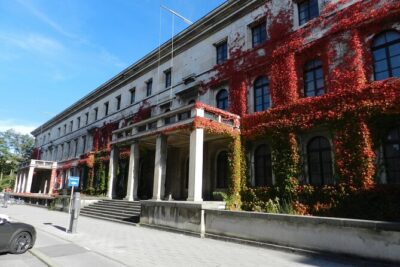
- Führerbau: the heavier chapter of Munich, handled with a guide
- The royal boulevard-and-church loop: Alte Pinakothek, Siegestor, Odeonsplatz
- Munich Residenz and the Odeonsplatz-to-park transition
- English Garden and Chinese Tower: the beer garden break that changes the day
- Eisbachwelle and the river vibe: park life in the middle of the city
- Viktualienmarkt and Ohel Jakob Synagogue: food and faith in the same ride
- Safety, helmets, and how to handle the traffic moments
- Price and value: what $70 gets you (and what it doesn’t)
- Who should book this tour
- Should you book Best of Munich Electric Bike Tour?
- FAQ
- How long is the Best of Munich Electric Bike Tour?
- Where is the meeting point?
- What’s included in the price?
- Is food or drinks included?
- Do I need cash?
- What do I need to bring?
- Is the tour suitable for children?
- Is the guide provided in English?
Key highlights worth planning around

- Königsplatz: an important royal-stage square that helps you understand Bavaria’s self-image
- Führerbau: a direct look at Munich’s darker chapter tied to the Nazi movement
- English Garden + Chinese Tower break: long enough to eat, wander, and reset your energy
- Eisbachwelle: the famous city-park wave where surfers ride in the middle of the park
- Viktualienmarkt + Ohel Jakob Synagogue: food-market energy and a different side of Munich’s cultural map
Why this Munich e-bike route works in just 4 hours
This tour is built for people who want Munich’s “greatest hits” without doing the dead-on-arrival workout that normal sightseeing can turn into. With an electric bike, you can keep a steady pace and still spend time looking up at buildings, not just down at your speed.
What makes it especially good value is the mix: you’re not only riding past pretty facades. You also get guided stops tied to the political history of the city, including the origins of the Nazi party at Führerbau. That contrast is what turns a bike loop into a real story.
The ride is also timed well for a first visit. It’s four hours, and your longer break lands in the English Garden area, so you finish with a relaxed-feeling park moment instead of ending on empty energy.
You can also read our reviews of more cycling tours in Munich


Starting at Karlspl. 4: easy logistics, lots of stops
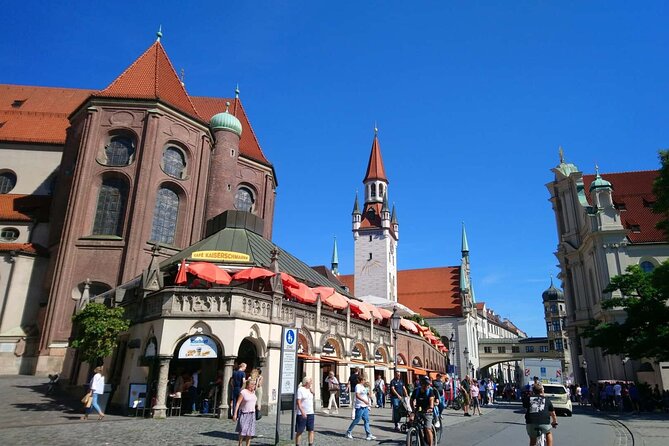
You start at Karlspl. 4, in the inner courtyard behind Sixt Car Rental. It’s a practical location: you’re not stuck guessing where “downtown tour meeting points” actually are.
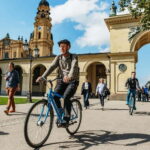
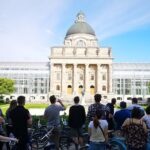
From there, the tour is run as a sequence of short photo stops. You’ll get quick looks at sights like Karolinenplatz and Königsplatz, then you move on before the group bottlenecks. For many people, that style is ideal—quick context, then forward motion.
One important note: you’ll want to be fully comfortable riding a bike on your own. Double trailers for toddlers, tag-a-long attachments, and kid’s seats are not permitted on the e-bikes, and kids under 14 are not suitable. That rule matters because it protects everyone’s safety and pacing, but it also means this is mostly for adults or older teens riding independently.
Königsplatz and the Bavarian royal story you can actually see
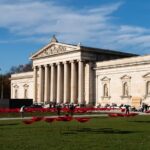
Königsplatz is the first big “wow” square, and it’s more useful than you might expect. This is where the tour brings you into the illustrious royal family of Bavaria—so instead of just admiring buildings, you start understanding why certain places look so intentionally grand.
The timing is smart: you see it early, while your brain is still fresh and you haven’t yet loaded up on too much history. You get a short viewing window (about five minutes), enough for the group to gather, listen, and line up photos.
If you love architecture and city planning, you’ll probably feel like you’re getting the framework of Munich, not just random stops. And because this is an e-bike tour, you can move on quickly without losing the momentum that sightseeing days can steal.
Führerbau: the heavier chapter of Munich, handled with a guide
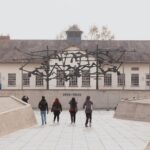
Then you shift to the darker side of Munich at Führerbau. The tour’s focus here is direct: you’ll learn about Munich’s darker history and the origins of the Nazi party tied to this area.
This stop is one of the reasons this tour feels more than “a nice ride.” You’re not skipping the hard parts, but you also aren’t thrown into a lecture with no structure. The guide’s job is to connect what you’re seeing to what it meant, and that makes a difficult topic more manageable.
A practical tip: give yourself a moment after the stop to reset. When you go from royal symbolism to political violence, it’s normal to feel a little whiplash. The e-bike makes it easier to move on, but your head may need a second to catch up.
The royal boulevard-and-church loop: Alte Pinakothek, Siegestor, Odeonsplatz
After the major square and Führerbau, you ride past more of Munich’s famous “royal backdrop” sights—churches, palaces, and royal boulevards in general terms—while stopping at the big named landmarks.
A few highlights in this stretch:
- Alte Pinakothek: you’ll have a short photo stop, and the guide helps tie it into Munich’s cultural identity
- Siegestor: another quick viewing moment that gives you a sense of how the city marks major themes in stone
- Odeonsplatz: you get a stop here that functions like a hinge between different eras of the city
These stops are short (around five minutes each), so don’t expect time to read every plaque. Instead, think of this section as a “guided orientation” phase. By the time you reach the English Garden, you’ll likely feel like you understand how Munich arranges its key visual landmarks—big squares, monuments, and institutions in a pattern you can follow on your own afterward.
You can also read our reviews of more tours and experiences in Munich
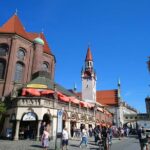
Munich Residenz and the Odeonsplatz-to-park transition
You’ll stop at Munich Residenz and Odeonsplatz as part of the royal story arc. Even if you only catch glimpses while the group rolls through, these stops help you make sense of how power and culture are visually linked in the city.
Then comes the transition toward the English Garden. This matters because the tour doesn’t keep you “on high alert” the entire time. After the political and royal material, you need a setting shift—and the English Garden delivers.
One small practical thing: the ride through central areas can involve traffic and intersections. The guide’s pacing and safety instructions are key here. If you’re a nervous rider, you may find this tour easier than a walking-only day, since the e-bike keeps you from constantly stopping and restarting your balance.
English Garden and Chinese Tower: the beer garden break that changes the day
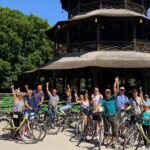
The most relaxing part of the tour is the English Garden area, including a stop at Chinese Tower. You get a break that lasts about 40 minutes, and it’s set up so you can actually eat, not just stand in line for two minutes and call it a meal.
The tour description includes street food, free time, and a food market visit with regional food. That mix is practical for visitors because you can choose what you feel like eating instead of being boxed into one fixed meal.
Also, Munich’s beer garden culture is a major part of the city’s identity, and the English Garden area is famous for it. You’re not just told to look at a park—you get an intentional stop in a place where people actually hang out and eat outside.
If you’re hungry for a local rhythm, this is where you’ll feel it: cyclists moving at a human pace, families and friends taking their time, and the park setting doing its job of lowering the stress level after denser sightseeing.
Eisbachwelle and the river vibe: park life in the middle of the city
After the break, the tour keeps moving through green space. Eisbachwelle is one of the standout stops because it’s tied to the famous city park surfers you’ve likely heard about. You’ll have a longer photo stop here (about ten minutes), which is important because the wave action can be quick and unpredictable.
Next you’ll stop at Angel of Peace, Munich, then Maximilianeum, and later at the Isar River. The effect of this stretch is that Munich stops feeling like a museum you’re walking through. It starts feeling like a city that still plays.
Isar River time helps too. The tour includes a short photo stop here, enough for you to understand the layout and see how the city uses the river as a natural corridor.
Just remember: this isn’t a sit-down boat cruise. It’s a bike tour, so you’ll be viewing fast and learning fast. If you want slower travel, treat these stops as “entry points.” After the tour, you can come back and linger on your own.
Viktualienmarkt and Ohel Jakob Synagogue: food and faith in the same ride
As the ride nears the end, you’ll stop at Viktualienmarkt and Ohel Jakob Synagogue. This pairing works because it shows Munich as more than royal history and major monuments.
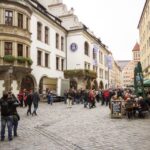
Viktualienmarkt is presented as a photo stop, and in practice it’s a great place to see how food-market life shapes daily city energy. Even if you don’t buy anything right there, it gives you a sense of where you’d go for local snacks later.
Ohel Jakob Synagogue is a strong contrast stop. It broadens the cultural picture so the tour doesn’t flatten Munich into one story thread. If you like cities that show multiple layers—royal, political, community—you’ll likely enjoy ending on this note.
Safety, helmets, and how to handle the traffic moments
This is an e-bike tour, so you get help with hills and longer distances. But it still involves real streets, and some parts can include higher-traffic conditions. One rider noted it felt a bit dangerous in those areas, while another praised the guide for keeping the group safe.
So here’s what I’d do if you’re deciding:
- Assume the ride may include intersections and busier roads, and keep your speed expectations realistic
- Pay attention at any instruction moments before the group rolls into traffic
- Make sure you’re actually using your helmet before you start
The good news: helmets are listed as included. Still, if you’re handed the bike first and the helmet later, or not at all, stop and ask. You’re there for history and sights, not for a preventable safety problem.
Price and value: what $70 gets you (and what it doesn’t)
At $70 per person for four hours, the value comes from three things: a live English guide, an electric bike, and a helmet. That’s a solid package if you want guided context without paying separately for a bike rental and a tour guide.
What you should plan for: food and drinks are not included, and you’ll need cash (EUR) for the dinner/snack stop because credit cards are not accepted there. That detail matters more than people think. It can turn a smooth meal break into a scramble if you show up with only plastic.
If you enjoy structured sightseeing, this price makes sense because you’re not just getting “transport.” You’re getting a guided sequence of major sights—Königsplatz, Führerbau, museum and monument stops, and then the English Garden reset.
Who should book this tour
This tour is a strong fit if:
- You want Munich’s highlights in four hours without tiring yourself out
- You like history that’s explained in context, including tough chapters
- You’re comfortable riding a bike on your own
It’s less ideal if:
- You’re pregnant (not suitable)
- You’re bringing children who can’t ride independently (no under-14 suitability, and no under-18 without an adult present)
- You rely on card payments for food and snacks (cash is required for the break stop)
If you’re the type of traveler who likes to end a day with fresh air and real local atmosphere, the English Garden stop is a strong reason to choose this over a more “museum-only” half day.
Should you book Best of Munich Electric Bike Tour?
I’d book it if you want a guided Munich loop that balances royal landmarks with the city’s difficult political history, then finishes in a park where people actually relax. The structure makes it easy to get oriented, and the guide quality can be a big factor—Rob G is specifically praised for making the tour meaningful and memorable, while also keeping the group safe.
I wouldn’t book it if you hate riding near traffic, because even with an e-bike you can run into busier road sections. And if you forget cash, you’ll feel that immediately at the snack and dinner stop.
If you’re prepared to ride, bring EUR cash for food, and treat the bike time as part sightseeing and part city-life sampling, this tour is a very practical way to get a lot of Munich in one day.
FAQ
How long is the Best of Munich Electric Bike Tour?
The tour lasts 4 hours.
Where is the meeting point?
You meet at Karlspl. 4, in the inner courtyard behind Sixt Car Rental.
What’s included in the price?
Your ticket includes a live guide, an electric bike, and a helmet.
Is food or drinks included?
No. Food and drinks are not included. There is a meal break, but you’ll pay for what you eat.
Do I need cash?
Yes. You should bring cash in EUR for the dinner and snack stop because credit cards are not accepted there.
What do I need to bring?
Bring a passport or ID card, a credit card, cash, and weather-appropriate clothing.
Is the tour suitable for children?
It’s not suitable for children under 14. Also, no guest under 18 will be given a bike without an adult over 18 present.
Is the guide provided in English?
Yes. The live tour guide provides the tour in English.