REVIEW · MUNICH
Munich Private Walking Tour With A Professional Guide
Book on Viator →Operated by Global Guide Services · Bookable on Viator
Marienplatz tells stories at walking speed. This private Munich tour strings together the big landmarks and the uncomfortable parts of 20th-century history, all with a guide who adjusts to your questions. I like the private format because you are not squeezed into a crowd, and I love how the route connects streets, rulers, and turning points like the Beer-Hall-Putsch rather than treating them like separate facts.
You start right where Munich’s center comes alive, at Fischbrunnen near Marienplatz, and the walk stays easy on your legs. The tour is in English, runs about 2 hours, and is designed so you can ask for more detail on the parts that grab you—whether that is the monarchs of Bavaria or the rise of Hitler’s movement.
One thing to plan for: entrance fees are not included. That usually means you get the most from exterior views and stories, and if you want to step inside a site, you’ll likely need to pay separately.
In This Review
- Key things I’d plan around
- Where this tour really starts: Marienplatz’s Glockenspiel zone
- St. Peter and Frauenkirche: faith, views, and a legendary footprint
- Odeonsplatz and the Beer-Hall-Putsch: the street-level lesson
- Theatine Church and Ludwigstrasse: power shown through architecture
- Max-Joseph-Platz and the Residence: Munich’s monarchs, close up
- Hofbräuhaus and Viktualienmarkt: beer hall tradition meets real life
- The private-guide advantage: how it changes the experience
- Price and value: what $305.11 buys you
- Timing and how to plan your day around it
- Who should book this tour (and who might skip it)
- Should you book this Munich Private Walking Tour?
- FAQ
- FAQ
- What is the duration of the Munich private walking tour?
- How much does the tour cost?
- Is the tour private or shared?
- What language is the tour offered in?
- Is a mobile ticket provided?
- Are entrance fees included?
- Where does the tour start?
- Do I need transportation during the tour?
- Is the walking tour easy for most people?
- What is the cancellation policy?
Key things I’d plan around
- Private guide, up to 15 people: You get a group that stays flexible and conversation-friendly.
- Marienplatz’s Glockenspiel details: 43 bells, 32 figures, and performances tied to fixed hours.
- Religious landmarks in a tight loop: St. Peter, then views toward Frauenkirche and its famous legend.
- Odeonsplatz and the Beer-Hall-Putsch: A clear, street-level way to understand Munich’s darker crossroads.
- Monarchs to modern Munich through the Residence and beer halls: Royal palace exterior views, then Hofbräuhaus founded in 1589.
- Viktualienmarkt at the end: Fresh local food market energy, perfect for a snack or lunch plan.
Where this tour really starts: Marienplatz’s Glockenspiel zone
You begin near Fischbrunnen on Marienplatz itself, which is smart. It puts you in the middle of the city’s postcard cluster, but it also means your guide can build the story from the ground up: why this square matters, what the clock tower is, and what the city has chosen to celebrate.
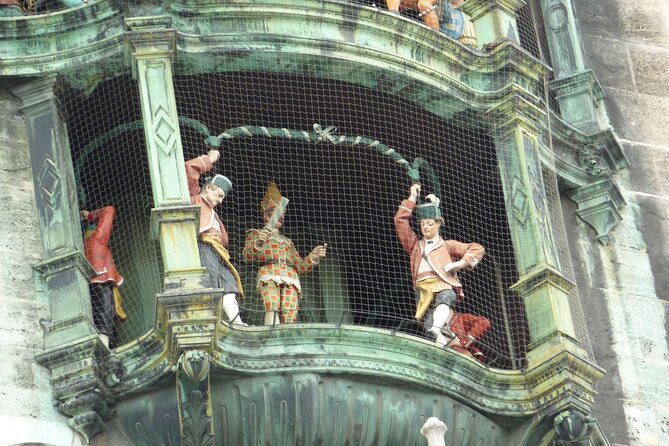
The first major stop is the Rathaus-Glockenspiel area. You’ll hear how Mary’s Column helped name the square, then connect that to the Old and New Town Halls. The clock tower is the headline: it has 43 bells and 32 figures, and it performs with wooden figurines at set times. If your timing is right, you can watch those moments as part of the walk instead of treating them as a separate attraction you have to schedule later.
What I like here is that it is not just sightseeing. The guide’s job is to give you a storyline so the tower feels like a living piece of Munich, not a random ornament. And because this is private, you can ask what you want: art and symbolism, or just the simplest explanation of what’s happening when the figurines move.
You can also read our reviews of more walking tours in Munich
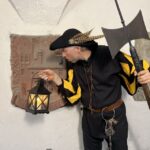
St. Peter and Frauenkirche: faith, views, and a legendary footprint
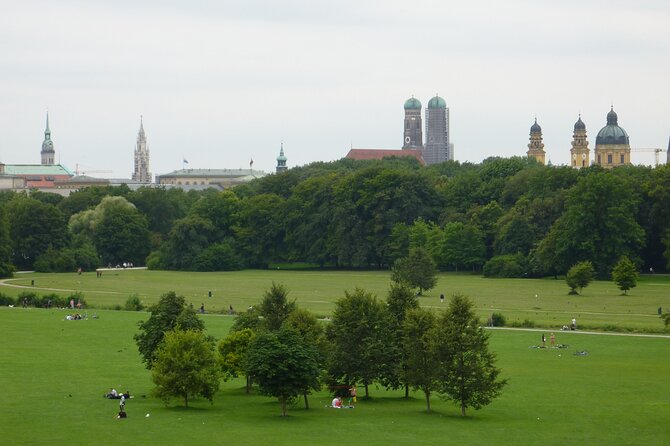
Right after the bells-and-figures excitement, you move a short step to St. Peter, described as the oldest Catholic church in the city. Even if you only catch an exterior look, this is an easy mental contrast: the clock tower is civic drama, while St. Peter roots you in older religious continuity.
Then the walk turns toward the cathedral Frauenkirche. You’ll get a good look at the famous double towers, plus the story that comes with the church’s dark legend. The “footprint of the devil” is the kind of Munich detail that sounds like folklore until your guide explains why it stuck around and what it meant to people living near this place over time.
A small practical note: this section is all about sightlines. You’ll do best if you position yourself where your guide is standing or gesturing, because the value is in seeing the features clearly while hearing the explanation. Comfortable shoes help too, because you’re moving steadily through a compact historical pocket.
Odeonsplatz and the Beer-Hall-Putsch: the street-level lesson
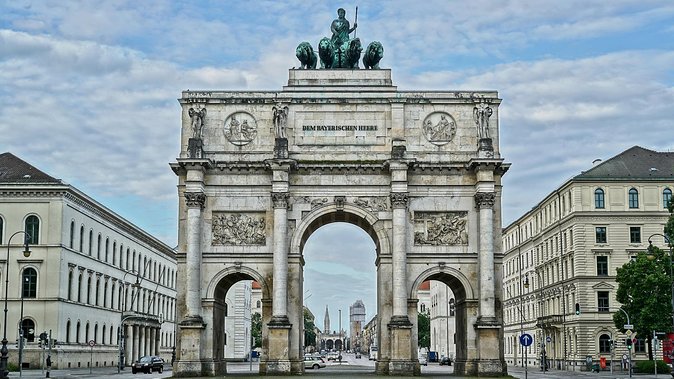
Next comes Odeonsplatz, and this is where the tour gets serious. You’ll learn about the Beer-Hall-Putsch, including the night when about 2,000 men marched toward the center of Munich under Adolf Hitler’s leadership, attempting to seize power.
This stop matters because it puts an event you may know from textbooks directly into the geography of Munich. Your guide can connect why this location is remembered, what it signaled at the time, and how the city’s political story intersects with its public spaces. For many people, this is the emotional pivot of the whole walk—the moment where the tour feels less like sightseeing and more like understanding how history happened in real places.
I also like that you can keep asking questions here. If you want the simplest timeline, you can go that direction. If you want broader context on how Munich’s political climate evolved, you can request it on the spot.
Theatine Church and Ludwigstrasse: power shown through architecture
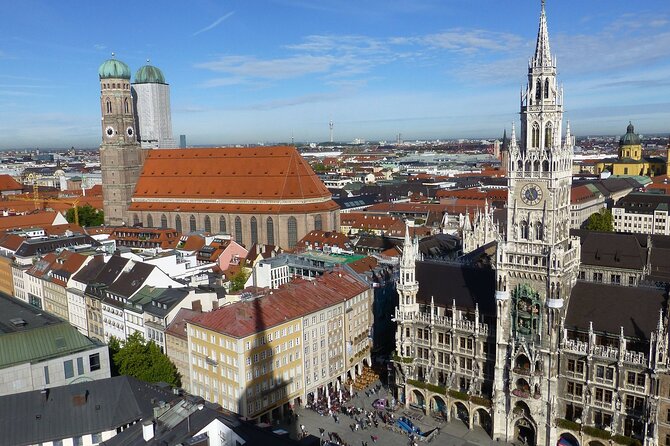
After the heavy material, the route turns to two kinds of visual storytelling: gratitude-by-architecture and state ambition.
You’ll pass the Theatine Church, a baroque church tied to Bavarian Electors. It was built by Ferdinand Maria and his wife as a thank-you gesture for the birth of a long-awaited heir, Prince Max Emanuel. That single fact does a lot. It shows you how dynasties communicated with buildings, using architecture as a public record of family stakes and political legitimacy.
From there, you see Ludwigstrasse, described as neo-classical. This street is more than a backdrop. It is linked with institutions such as the State Library and the oldest university of Munich, plus it connects toward the Gate of Victory. If you care about how cities brand themselves—through education, public monuments, and formal streets—this stretch is where the puzzle pieces start to click.
Because it is a walking tour with a guide who can adjust, you can spend more time on the bits that interest you. If you want a quick sweep, you can keep moving. If you want to linger for explanations, your guide can work with your pace.
Max-Joseph-Platz and the Residence: Munich’s monarchs, close up
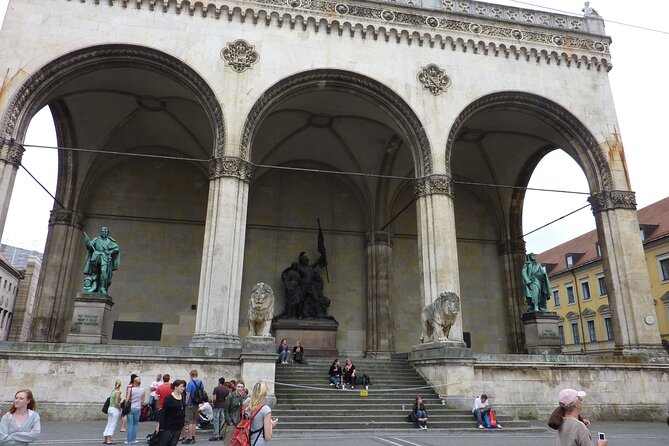
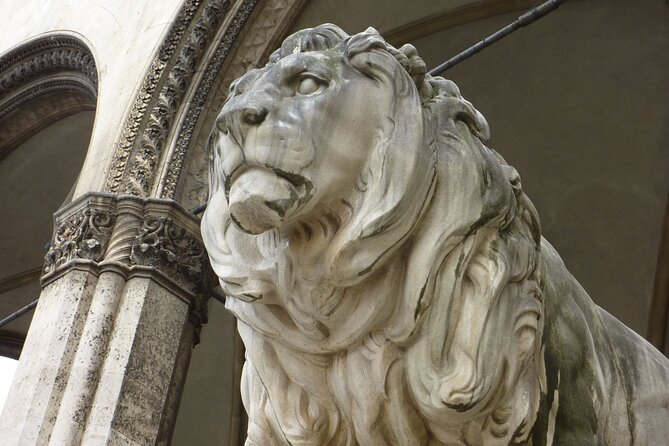
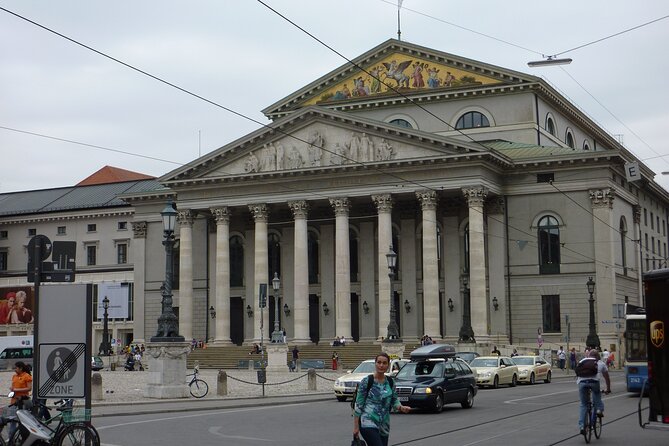
At Max-Joseph-Square (Max-Joseph-Platz), you get views of the Opera and the National Theater. Then the route shifts to the Residence, described as the former palace of the Bavarian monarchs and the largest palace in all of Germany.
Even when you are not going inside, the Residence stop helps you understand how the “royal” story shaped the city. This is the kind of place that makes Munich feel intentional—built with authority in mind. Your guide ties these structures back to the theme of rulers and power, so the walk feels like one connected narrative instead of a list of stops.
If you like your tours to answer questions like why something looks the way it does, this is where you’ll benefit most from asking. The architecture and street placement can be confusing at first, and a good guide helps you read it.
You can also read our reviews of more guided tours in Munich



Hofbräuhaus and Viktualienmarkt: beer hall tradition meets real life
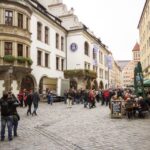
You end with two very different but perfectly complementary stops: the royal brewery Hofbräuhaus and then Viktualienmarkt.
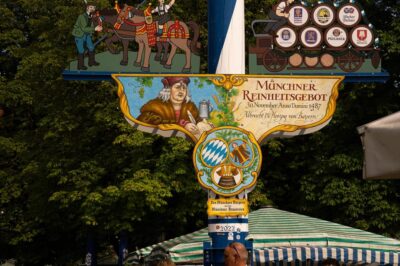
Hofbräuhaus is established in 1589 and often considered the mothership of all beer halls in the world. Even if you don’t go in for a formal sit-down experience, the point of this segment is atmosphere. It is a fast way to shift from “museum mode” back to Munich as a working city where people meet, eat, and talk.
Then Viktualienmarkt brings you to everyday life: a public food market with fresh local products. Ending here is smart because you leave the tour with an easy next move. If you’re hungry, you can grab something directly in the market area. If you’re not hungry, you still get that local texture—produce, vendors, and the sense that Munich is more than historic façades.
Practical thought: since entrance fees are not included, you should treat any paid entry you want (to churches, halls, museums, or interiors) as an optional add-on. This tour is best at the outdoor, street-level storytelling, and that is where it delivers the strongest value.
The private-guide advantage: how it changes the experience
With a private tour, the biggest difference is how easily you can steer the conversation. The walk is designed for groups that stay together, and the guide is with your group only. That means:
- You can ask as many questions as you want.
- You can request customization on the spot.
- You are not stuck listening to a one-size-fits-all script.
In the feedback you can find a pattern: guides like Tom Lipton are praised for wit and storytelling, while Peter is noted for being accommodating and sharply informative. The takeaway for you is not that one specific name guarantees the same experience every time. It’s that the tour format supports a more fun, personality-driven delivery than a rigid group bus tour.
Still, keep one caution in mind. One past experience pointed out that a guide with a voice that was too quiet made it hard for some people to hear. If listening is central for you, position yourself where you can clearly hear the guide, and don’t hesitate to ask for them to repeat or slow down when needed.
Price and value: what $305.11 buys you
This tour costs $305.11 per group for up to 15 people, for about 2 hours. On a cost-per-person basis, it can be a bargain if you travel with others who also want history, not just photos.
At the maximum group size (15 people), the math comes out to roughly $20 per person for a private guided walking experience. Even if your group is smaller, you still get three real value drivers:
- Private guidance instead of a large, slow-moving crowd.
- A route that covers both big attractions and the political turning points tied to Munich.
- Customization on the spot, so you’re not paying for a fixed checklist.
If you are traveling solo or as a duo, it can still be worth it when you want conversation and you dislike feeling rushed. But if you are mainly collecting quick landmarks and you don’t care about deeper context, a cheaper self-guided option might be more efficient.
Timing and how to plan your day around it
Because the tour is about 2 hours and starts at Marienplatz/Fischbrunnen, it fits nicely as an early or mid-day activity. It also helps you orient yourself fast. You’ll cover a tight loop through central Munich, so later in the day you can branch out with fewer questions.
The Rathaus-Glockenspiel has performances at fixed hours. You can’t control the schedule, but planning your arrival near the start time can help you catch the action if timing lines up. Even if you miss the figures, you still get the explanation and the structure of the clock tower.
Wear easy walking shoes. The activity level is listed as easy, but you are still on your feet through central streets and squares.
Who should book this tour (and who might skip it)
This is a strong pick if you:
- Want a private, question-friendly way to understand central Munich.
- Like history that includes both cultural icons and harder political chapters.
- Prefer seeing many highlights in a short time without the hassle of transportation.
You might skip it if you:
- Are only interested in interiors or ticketed museum time, since entrance fees are not included and the emphasis is walking and viewing.
- Want a purely laid-back photo walk with minimal explanation.
Should you book this Munich Private Walking Tour?
If your idea of a great Munich day is a smooth, guided history walk that ties together Marienplatz, major churches, political landmarks, royal power sites, and ends with a real market mood, then yes, it’s an easy yes. The price makes more sense when you go as a group, but the private format is the real selling point: you get a guide who can respond to your interests while keeping the pace comfortable.
Just plan for outdoor viewing as the main experience, and if you want to go inside paid sites, budget entrance fees separately.
FAQ
FAQ
What is the duration of the Munich private walking tour?
It runs for about 2 hours.
How much does the tour cost?
The price is $305.11 per group, up to 15 people.
Is the tour private or shared?
It is private. Only your group participates.
What language is the tour offered in?
The tour is offered in English.
Is a mobile ticket provided?
Yes, the tour includes a mobile ticket.
Are entrance fees included?
No, entrance fees are not included.
Where does the tour start?
It starts at Fischbrunnen, Marienplatz 8, 80331 München, Germany.
Do I need transportation during the tour?
No transportation is needed.
Is the walking tour easy for most people?
Yes. The activity level is listed as easy, and most travelers can participate. It is also suitable for any age.
What is the cancellation policy?
There is free cancellation. You can cancel up to 24 hours in advance for a full refund.